System Information Block Type 1 (SIB1)

Introduction: 

            When a device (UE) powers on and searches for a 5G network, it needs essential system information before establishing a connection. This information is broadcast by the gNB in the form of System Information Blocks (SIBs). Among these, SIB1 plays a critical role in enabling the UE to access the network.

What is SIB1?
SIB1 stands for System Information Block Type 1. It is part of the Radio Resource Control (RRC) layer and is transmitted on the BCCH over DL-SCH channel. After decoding the Master Information Block (MIB) from PBCH, the UE reads SIB1 to learn how to proceed with cell selection and request additional system information.

Why is SIB1 Important below are the some Key pointer?
  • Provides cell access parameters such as PLMN identity, Tracking Area Code, and Cell Identity.
  • Informs the UE about access restrictions (e.g., cell barred, access barring for certain categories).
  • Contains serving cell configuration for initial access.
  • Specifies how other SIBs are scheduled (periodic or on-demand).
  • Includes connection failure control and system information versioning.
High level Contents of SIB1:

Here’s a simplified breakdown of what SIB1 includes:
1. Cell Access Related Info
  • PLMN Identity List
  • Tracking Area Code (TAC)
  • Cell Identity
  • Access barring parameters
2. Serving Cell Configuration
  • Common configuration for initial access
  • Frequency and bandwidth info
  • Subcarrier spacing and timing parameters
3. SI Scheduling Info
  • How and when other SIBs (SIB2, SIB3, etc.) are broadcast
4. Connection Establishment Failure Control
  • Rules for handling repeated RRC failures
5. System Info Value Tag
  • Helps UE detect changes in system information


5G (NR): DAPS Handover

 Introduction to DAPS Handover 

         In this article, we will discuss the basics of DAPS (Dual Active Protocol Stack) Handover in 5G networks. 

What is DAPS Handover?

         DAPS (Dual Active Protocol Stack) handover is a handover procedure designed to minimize interruption during the transition between cells. In this mechanism, the User Equipment (UE) maintains the source gNB configuration even after receiving the Handover Command and continues using it until the Random Access (RACH) procedure at the target gNB is successfully completed.


 Key Characteristics of DAPS Handover: 

 • UE continues transmission (TX) and reception (RX) on the source cell after receiving the handover request. 

 • UE performs simultaneous reception of user data from both source and target cells. 

 • UE switches uplink (UL) transmission to the target cell after completing the RACH procedure.

 • DAPS reduces handover interruption time to almost 0 ms by maintaining the source radio link while establishing the target radio link. 

 • DAPS handover is supported over both Xn and NG interfaces. 

 • It can be used for RLC AM (Acknowledged Mode) or RLC UM (Unacknowledged Mode) bearers. 

 • Downlink Data Forwarding is mandatory during a DAPS Handover


NG-Based DAPS Handover Call Flow:

Step 1: UE sends a Measurement Report to the Source CU, which decides whether to perform a Normal or DAPS Handover.

Step 2: Source CU sends F1AP: UE Context Modification Request to the Source DU with IE gNB-DUConfigurationQuery = TRUE.

Step 3: Source DU responds with UE Context Modification Response including Cell Group Configuration.

 Step 4: Source CU sends NGAP: Handover Required to AMF with DAPS Request Information.

 Step 5: AMF forwards NGAP: Handover Request to Target CU with the same DAPS Request Information.

 Step 6: Target CU sends F1AP: UE Context Setup to Target DU along with Handover Preparation Information.

 Step 7: Target DU responds with UE Context Setup Response including Cell Group Configuration.

Step 8: Source CU sends NGAP: Handover Request Acknowledge to AMF with RRC Reconfiguration and DAPS Response Information.

Step 9: AMF sends NGAP: Handover Command to Source CU with the same RRC Reconfiguration and DAPS details.

Step 10: Source CU forwards F1AP: UE Context Modification to Source DU with RRC Container (HO Command) and DAP_HO_Status = Initiation.

Step 11: UE receives HO Command and performs RACH procedure at Target Cell while still receiving DL data from Source gNB.

Step 12: Source CU sends NGAP: Uplink Early Status Transfer to AMF, which forwards it to Target CU as NGAP: Downlink Early Status Transfer.

 Step 13: After completing RACH, UE sends RRC Reconfiguration Complete to Target Node and switches UL data to Target gNB.

 Step 14: Target CU sends NGAP: Handover Notification to AMF with IE Notify Source NG-RAN Node.

Step 15: AMF sends NGAP: Handover Success to Source CU.

Step 16: Source CU sends F1AP: UE Context Modification to Source DU with TransmissionActionIndication = Stop, stopping DL data transmission.


Step 17: Source CU sends NGAP: Uplink Status Transfer to AMF, which forwards it to Target CU via Downlink Status Transfer.

Step 18: AMF sends NGAP: UE Context Release to Source CU, which clears the UE context and responds.

Step 19: Target CU sends RRC Reconfiguration to UE with daps-SourceRelease and UE responds with RRC Reconfiguration Complete


MSG1 – PRACH in 5G NR


What is MSG1 in 5G?

        MSG-1 is the first message in the Random Acccess Procedure of 5G (NR). It is transmitted by the User Equipment (UE) to the gNodeB (gNB) over the Physical Random Access Channel (PRACH).

MSG1 contains a Random Access Preamble, which is a special signal used by the UE to:

  • Request initial access to the network
  • Re-establish connection after radio link failure
  • Perform handover
  • Synchronize uplink timing

Why is MSG1 Required?

MSG1 is essential because:

  • The UE doesn’t yet have uplink timing aligned with the gNB.
  • It allows the gNB to detect the UEmeasure timing offset, and allocate resources.
  • It initiates communication when the UE is in RRC_IDLERRC_INACTIVE, or during beam failure recovery.

MSG1 Structure (PRACH Preamble)

MSG1 is not a regular/normal message with headers and payload. It’s a waveform generated using Zadoff-Chu sequences. It includes:

FieldExplanation
Preamble IndexIdentifies which preamble UE is using (used for contention resolution).
Sequence FormatLong (839) or Short (139) depending on cell size and deployment scenario.
Subcarrier Spacingit is not constant varies by frequency range (like FR1: 15/30 kHz, FR2: 60/120 kHz).
PRACH Configuration IndexDetermines time/frequency resources for PRACH transmission.
RA-RNTIit is used to identify the UE. it is being used during Random Access Procedure only.
it stands for  "Random Access Radio Network Temporary Identifier"
How MSG1 is Transmitted
  1. UE selects a preamble index and PRACH resource based on configuration from SIB1 or RRC.
  2. UE transmits the PRACH waveform using selected format and power.
  3. The transmission is blind—UE doesn’t know if gNB received it.


What Happens at gNB After Receiving MSG1?

Once gNB receives MSG1:

  1. It detects the preamble and estimates timing offset.
  2. It sends MSG2 (Random Access Response) via PDCCH and PDSCH.
  3. MSG2 includes:
    • Timing Advance
    • Temporary C-RNTI
    • Uplink grant for MSG3

If multiple UEs send the same preamble (contention-based access), gNB resolves it in later steps (MSG4).


MSG1 in the Full Random Access Procedure


UE                                                                    gNB
│                                                                          │
├── MSG1: PRACH Preamble   ─────▶│  (Initial access)
│◀── MSG2: RAR (Timing, Grant)    ── ┤
├── MSG3: RRC Setup Request  ────▶│
│◀── MSG4: Contention Resolution  ──┤

NR Interview Questions:

 LTE/NR Interview Questions 

 ———————1st———————————

1. What is 5G and why do we need it over existing LTE? - OK

 2. SA and NSA mode operation- OK

 3. Sub 6[FR1] and mmWave [FR2] - OK

 4. 5G Numerology [SCS/Subcarrier spacing details], RE, RB- 

 5. 5G supported Bandwidth, MCS, MAS, FR1, and FR2 supported bands as per 3GPP Rel 15/16

 6. 5G service-based architecture

 7. 5G Deployment options [option 2/3/3a/3x/5/6/7/7a/7x]

 8. 5G supported main features- eMBB, Network slicing, URLCC, mMTC, Massive MIMO, Beamforming, etc

 9. 5G NSA and 5G SA power on call flow with each message/IE

 10. 5G protocol stack, channels, Frame structure, and physical layer parameters

———————2nd———————————

1. Difference between 3, 3a and 3x deployment options?

2. 5G gNodeB architecture?

3. Functionality of 5G MAC, RLC and PDCP compared to LTE?

4. Explain about 5G NR new protocol SDAP?

5. 5G SA and NSA registration call flow and VoNR call flow?

6. 5G throughput calculation formula and main parameters?

7. CORESET in 5G and how does it different from LTE corset?

8. 5G core major interfaces?

9. Network slicing, S-NSSI, SST, and SD?

10. Explain about SSB?

———————3rd———————————

1. 5G NR BWP Types and BWP Operations?

2. Explain DCNR and MRDC ?

3. Explain MU MIMO and Massive MIMO?

4. 5G TDD and FDD frame structure?

5. 5G NR PDCP ROHC modes and profiles supported?

6. Signaling radio bearers and importance of SRB 3?

7. 5G NR UE and Network identifiers?

8. 5G NR Modulation and Coding Scheme (MCS) Characteristics?

9. 5G NR PSS and LTE PSS comparison?

10. 5G NR SSS and LTE SSS comparison?

———————4th———————————

1. 5G UE category types?

2. 5G NR Transport block size[TBS] calculation?

3. 5G NR RACH procedure and RACH types?

4. 5G NR CBRA and CFRA RACH?

5. 5G NR SCG failure, Beamforming failure, and RLF log analysis and debug?

6. 5G NR Measurements: RSRP, RSSI, RSRQ, and SINR?

7. Handovers in 5G?

8. Explain QOS in 5G?

9. 5G NR Logical, Transport, and Physical Channels Mapping?

10. 5G NR Radio Network Temporary Identifier (RNTI) and RNTI types?

———————5th———————————

1. Handover call flow in detail (conurer questions like: path switch, SN status transfer ) 

2. 256 qam related link adaptation (DL UL link adaptation , alt cqi table)

3. TTI bundling

4. Sps (its an volte feature)

5. Call flow in detail (rach, Ue id acquisition, location update related counter questions )

6. Emergency call flow

7. Establishment cause (like in what case what establishment cause will come)

8.DL UL throughput debugging

9. SON (ANR, MRO)

SRS(Sounding reference signal) in NR:

 SRS(Sounding reference signal) in NR:

       In the world of 5G New Radio (NR), efficient and accurate uplink channel estimation is crucial for maintaining high data rates and reliable connectivity. One of the key tools used for this purpose is the Sounding Reference Signal (SRS).


What is SRS?

          SRS is a type of uplink reference signal transmitted by the User Equipment (UE) to help the gNodeB (5G base station) assess the quality of the uplink channel. Unlike other reference signals that are tied to data transmission, SRS is often sent independently of data, purely for the purpose of channel sounding.


Why is SRS Important in 5G?

5G networks operate across a wide range of frequencies, including millimeter wave bands, where channel conditions can vary rapidly. SRS helps the network:

  • Estimate uplink channel quality across different frequency resources.
  • Support beamforming and massive MIMO by providing spatial channel information.
  • Enable frequency-selective scheduling, allowing the network to assign resources based on real-time channel conditions.
  • Assist in mobility management, especially in scenarios involving handovers or dual connectivity.

How Does SRS Work?

The gNodeB configures the UE to transmit SRS periodically or on-demand. These signals are sent over specific resource blocks and are designed to be orthogonal to other uplink transmissions to avoid interference.

Key aspects of SRS configuration include:

  • Bandwidth and frequency hopping: SRS can span wide bandwidths and hop across frequencies to provide a comprehensive channel view.
  • Time-domain configuration: SRS can be scheduled at regular intervals or triggered dynamically.
  • Antenna port mapping: In MIMO setups, SRS can be transmitted from multiple antenna ports to help the gNodeB understand spatial characteristics.

1. SRS Triggering Mechanisms

SRS transmission can be initiated in two main ways:

  • Periodic Triggering: The UE sends SRS at regular intervals based on a predefined schedule.
  • Aperiodic Triggering: The gNodeB can request SRS on-demand via Downlink Control Information (DCI), allowing dynamic channel sounding when needed.

This flexibility helps balance overhead and responsiveness.


2. Time-Domain Configuration

SRS can be configured to occur in specific time slots or symbols. Key parameters include:

  • SRS Periodicity: Defines how often the UE should transmit SRS (e.g., every 20 ms, 40 ms).
  • Offset: Determines the starting point of the periodic transmission within a frame.
  • Duration: Specifies how many symbols are used for SRS in a slot.

This allows operators to optimize SRS timing based on traffic load and mobility.


3. Frequency-Domain Configuration

SRS can be transmitted over a wide or narrow frequency range. Important aspects include:

  • Bandwidth Configuration: SRS can span multiple resource blocks (RBs), enabling wideband channel estimation.
  • Frequency Hopping: SRS can hop across different frequency locations to provide a broader view of the channel.
  • Comb Size: Determines the spacing between SRS tones, affecting resolution and overhead.

These settings help the gNodeB assess frequency-selective fading and optimize resource allocation.


4. Spatial Configuration

In MIMO systems, SRS can be transmitted from multiple antenna ports. This supports:

  • Uplink Beamforming: By analyzing SRS from different spatial directions, the gNodeB can select optimal beams.
  • Channel Reciprocity: In TDD systems, uplink SRS can help infer downlink channel conditions.

This is especially useful in massive MIMO deployments.


5. Group and Sequence Configuration

SRS uses specific sequences and cyclic shifts to maintain orthogonality between UEs:

  • Sequence Group and ID: Defines the base sequence used for SRS.
  • Cyclic Shift: Allows multiple UEs to transmit SRS simultaneously without interference.

This ensures scalability and efficient multi-user support.


6. SRS Resource Configuration

The gNodeB defines SRS resources using RRC signaling. Each resource includes:

  • Resource ID
  • Time and frequency allocation
  • Antenna port mapping
  • Transmission comb and sequence parameters

These configurations are managed via the SRS-Config structure in the RRC protocol.


SRS Configuration Summary Table

ParameterDescription
Trigger TypePeriodic or Aperiodic (on-demand via DCI)
PeriodicityDefines how often SRS is transmitted (e.g., every 20 ms, 40 ms)
OffsetTime offset within the frame for periodic SRS
DurationNumber of OFDM symbols used for SRS in a slot
Bandwidth ConfigurationNumber of resource blocks (RBs) allocated for SRS
Frequency HoppingEnables SRS transmission across different frequency locations
Comb SizeSpacing between SRS tones (e.g., 2, 4, 8)
Antenna PortsNumber of antenna ports used for SRS (supports MIMO and beamforming)
Sequence Group & IDDefines the base sequence used for SRS
Cyclic ShiftAllows multiple UEs to transmit SRS simultaneously without interference
SRS Resource IDUnique identifier for each configured SRS resource

What is containerd and how its works:

What is containerd?

If you're exploring container technologies like Docker or Kubernetes, you might have come across the term containerd. It sounds technical, but understanding it is easier than you think—and it's essential for grasping how modern container systems work.


What is containerd?

containerd is a container runtime—a core component responsible for managing the lifecycle of containers. It handles tasks like:

  • Pulling container images
  • Starting and stopping containers
  • Managing storage and networking
  • Supervising container execution

Think of containerd as the engine that powers containers behind the scenes. It doesn’t have a user interface or fancy commands—it’s designed to be used by higher-level tools like Docker or Kubernetes.


How containerd Works

Here’s a simplified breakdown of how containerd operates:

  1. Image Management
    containerd can pull container images from registries (like Docker Hub) and store them locally. It uses a component called content store to manage image layers efficiently.

  2. Container Lifecycle
    It creates containers from images, starts them, stops them, and deletes them when no longer needed. This includes setting up the filesystem, networking, and process isolation.

  3. Snapshotting
    containerd uses snapshotters to manage container filesystems. These allow containers to share base layers and save disk space.

  4. Runtime Execution
    containerd delegates the actual execution of containers to a lower-level runtime like runc, which uses Linux namespaces and cgroups to isolate processes.

  5. gRPC API
    containerd exposes a gRPC API, which allows other tools (like Docker or Kubernetes) to interact with it programmatically.


containerd vs Docker

You might wonder: Is containerd the same as Docker?

Not quite. Docker is a complete platform for building, running, and managing containers. containerd is just the runtime part of Docker. In fact, Docker uses containerd internally to do the heavy lifting.

So, if Docker is the car, containerd is the engine.


containerd in Kubernetes

Kubernetes doesn’t need Docker to run containers—it can use containerd directly. This makes Kubernetes setups lighter and faster, especially since Docker support was deprecated in Kubernetes v1.20+.


Why Developers Love containerd

  • Lightweight: It’s minimal and focused only on container lifecycle management.
  • Reliable: Backed by the Cloud Native Computing Foundation (CNCF).
  • Flexible: Works with Kubernetes, Docker, and other orchestration tools.
  • Secure: Designed with modern container security practices.


Ciphering and Integrity in 5G


Ciphering in 5G

Ciphering, or encryption, is a fundamental security measure in 5G networks. It ensures that data transmitted over the network remains confidential and is only accessible to authorized parties. Here’s a comprehensive look at how it works:

Purpose of Ciphering

  • Confidentiality: The primary goal is to protect the data from being read by unauthorized entities. This is crucial for maintaining user privacy and securing sensitive information.
  • Data Protection: Ensures that any intercepted data cannot be understood without the proper decryption key.

How Ciphering Works

  • Encryption Algorithms: Ciphering uses specific algorithms to transform plaintext (readable data) into ciphertext (unreadable data). In 5G, the following algorithms are commonly used:
    • NEA0: No encryption, used mainly for testing purposes.
    • 128-NEA1: Based on the SNOW 3G algorithm, which is a stream cipher.
    • 128-NEA2: Uses the Advanced Encryption Standard (AES) in Counter (CTR) mode, a widely trusted encryption method.
    • 128-NEA3: Based on the ZUC algorithm, another stream cipher designed for high efficiency and security.

Process of Ciphering

  1. Key Generation: A unique encryption key is generated for each session. This key is shared between the sender and receiver.
  2. Encryption: The plaintext data is encrypted using the chosen algorithm and the session key, resulting in ciphertext.
  3. Transmission: The ciphertext is transmitted over the network.
  4. Decryption: Upon receiving the ciphertext, the receiver uses the same algorithm and session key to decrypt the data back into plaintext.

Integrity in 5G

Integrity protection ensures that the data received is exactly what was sent, without any alterations. This is vital for maintaining the trustworthiness of the communication.

Purpose of Integrity Protection

  • Data Integrity: Ensures that the data has not been tampered with during transmission. This is crucial for preventing data corruption and unauthorized modifications.
  • Authentication: Verifies that the data comes from a legitimate source.

How Integrity Protection Works

  • Message Authentication Code (MAC): Integrity protection involves generating a MAC, a small piece of information used to authenticate a message.
  • Algorithms Used: Similar to ciphering, integrity protection uses specific algorithms to generate and verify the MAC. Common algorithms include:
    • NIA0: No integrity protection, used for testing.
    • 128-NIA1: Based on SNOW 3G.
    • 128-NIA2: Uses AES in Cipher-based Message Authentication Code (CMAC) mode.
    • 128-NIA3: Based on ZUC.

Process of Integrity Protection

  1. MAC Generation: The sender generates a MAC using the data and a secret key.
  2. Transmission: The data and MAC are sent together over the network.
  3. MAC Verification: The receiver recalculates the MAC using the received data and the same secret key. If the recalculated MAC matches the received MAC, the data is considered intact and authentic.

Importance of Ciphering and Integrity in 5G

  • Enhanced Security: Together, ciphering and integrity protection provide a robust security framework for 5G networks, safeguarding against eavesdropping, tampering, and unauthorized access.
  • User Trust: By ensuring data confidentiality and integrity, these mechanisms help build and maintain user trust in the network.
  • Regulatory Compliance: Adhering to security standards and regulations is essential for network operators, and these mechanisms help achieve compliance.

DCI_Format 0_0 Decoder:

DCI Format 0_0:

This is used for the scheduling of PUSCH in a single cell and it is shared by gNB to UE in DL direction. UE is required to decode the UL grant on PDCCH, so that the UE can transmit PUSCH on UL Slot in Uplink. DCI 0_0 is mainly used for common search space signaling and UL Grant.

Field of DCI 0_0:

Add program

Decoder


Number of BWP RBs :

UL-DCI HexValue      :

Binary value :

DCI Fields No of bits Bits Decimal value
Identifier for DCI formats 1
Frequency domain resource assignment  
Time domain resource assignment 4
Frequency hopping flag 1
Modulation and coding scheme 5
New data indicator 1
Redundancy version 2
HARQ process number 4
TPC command for scheduled PUSCH 2
Padding Bits x
UL/SUL indicator x


5G(NR): Xn Based Handover

Introduction:

The basic handover and any type of mobility procedures are same in any type networks, i.e. UE measures the nearby signals and select the some good signals and make the report based on these signal strength and quality and after that sent this report to source cellsource cell take the decision to start handover procedure to best cell that is called Target Cell.  and then target cell completes the Handover procedure.


There are some basic Impotent Pointers for XN Handover:

------------------------------------------------------------------------------

  • Signal strength of both source gNodeB and target gNodeB should be reachable to UE during the handover, because during handover signaling are required with source gNB and target gNB also.
  • Xn-based Handover is very similar X2-based Handover in LTE
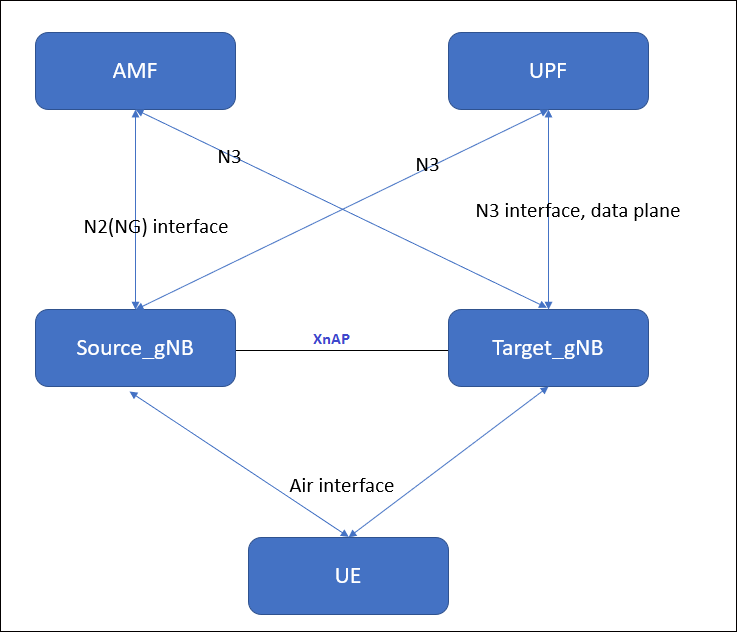
  • Xn-based handover is only possible if XnAP interface is established between source and Target gNBs.
  • This type of Handover is only applicable for intra-AMF mobility (with in same AMF ), i.e. Xn handover cannot be used if Source and Target gNB is connected to different AMFs.
  • Xn-based Handover can be both Intra Frequency handover and Inter Frequency handovers.
  • It is possible that source and target gNB can be connected with two different UPFs(user plane functions)
  • Tracking Area code should be same. RRC Re-Registration is requirred after Successful Handover if the Source gNB and the Target gNB belongs to different Tracking Area code (TAC).
  • Xn-based Handover is much faster as Compare to NGAP Handover due to short signaling root and 5G Core involved in only for switch the data path and PDU session.


High level setup diagram:

      Both source  gNB  and target gNB is serving by  same AMF and UPF. and source gNB and target gNB should have the active XNAP interface and active NGAP interface with AMF.


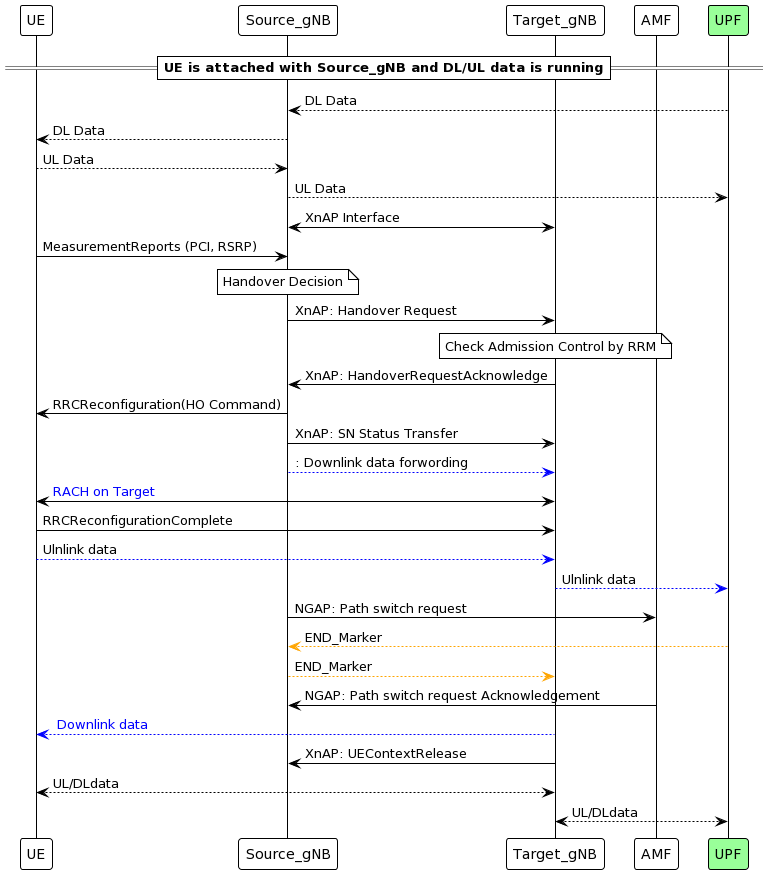
Signaling Exchange b/w Source gNB and target gNB is as shown in picture below..


Key Steps in Xn-Based Handover

1. Measurement Reporting

  • UE sends Measurement Report to Source gNB.
  • IEs:
    • MeasResults: Contains signal strength, quality, etc.
    • ReportConfigId: Identifies the reporting configuration.

2. Handover Decision

  • Source gNB decides to initiate handover based on measurements.
  • IEs:
    • TargetCellId: Identifies the target cell.
    • Cause: Reason for handover (e.g., signal degradation).

3. Handover Request (XnAP: Handover Request)

  • Source gNB → Target gNB via Xn interface.
  • IEs:
    • UE Context Information: Includes UE ID, security context.
    • RRC Context: RRC configuration for UE.
    • Bearer Contexts: QoS flows and data bearers.
    • Target Cell ID: Target gNB cell.

4. Handover Request Acknowledge (XnAP)

  • Target gNB → Source gNB.
  • IEs:
    • RRC Configuration: For UE to access target cell.
    • Admitted Bearers: Confirmed bearers for handover.
    • Target to Source Transparent Container: it contains RRC reconfiguration info that goes to UE.

5. Handover Command (RRC: RRCConnectionReconfiguration)

  • Source gNB → UE.
  • IEs:
    • MobilityControlInfo: Target cell info.
    • RadioBearerConfig: Setup for new bearers.
    • MeasurementConfig: New measurement settings.

6. Random Access Procedure

  • UE accesses target cell using contention-free or contention-based RA.
  • IEs:
    • RA-RNTIPreambleIndexTimingAdvance.

7. RRC Reconfiguration Complete

  • UE → Target gNB.
  • IEs:
    • ReconfigComplete: Confirms successful reconfiguration.

8. Path Switch Request (Optional if UPF changes)

  • Target gNB → AMF (if UPF needs update).
  • IEs:
    • UE ContextBearer InfoNew Tunnel Info.

9. Handover Notify (XnAP)

  • Target gNB → Source gNB.
  • IEs:
    • UE IDHandover Status.

10. Resource Release Command

  • Source gNB releases UE resources.
  • IEs:
    • UE IDRelease Cause.

Benefits of Xn-Based Handover

  • Low latency and minimal disruption.
  • No AMF/UPF involvement, reducing signaling overhead.
  • Efficient resource usage and load balancing.